Riding alone has its own pull, but a day out with a friend or a small group is often the one you remember longest. It takes a little more planning, though. Everyone rides differently, no two bikes have the same range, and nobody who doesn’t know the road wants to be left alone at a junction.
These tips cover what to sort out before you leave and what to agree on the road. They are not rules for every group: a couple who have ridden together for years work differently from five colleagues on their first ride out. Take what fits yours.
Pick a route that suits the most relaxed rider
The route shapes the day more than you might expect. Look beyond the distance to the ride time and the curviness. Every route page on Motarva shows them side by side, together with the elevation and the map, so you can tell before you set off whether a ride suits the least experienced rider, or the bike that is least at home on narrow, twisty roads.
For a group, a loop is usually the easiest choice: you start and finish in the same place, so nobody has to work out a way back. If you ride from A to B, agree beforehand how everyone gets home.
Browse the motorcycle routes on Motarva and filter by distance and curviness.
Make sure everyone has the route
If only the lead rider has navigation, the whole group stops the moment someone misses a turn. Send the link to the route page round before the ride. Anyone can view a route without an account; downloading the GPX needs a free account.
If not everyone knows how to get a GPX onto a Garmin, a TomTom or a phone, our guide to free GPX motorcycle routes walks through it step by step. Would you rather draw a ride for the group yourself? Use the route planner.
Agree who leads and who rides at the back
Five minutes of talking in the car park saves a lot of hassle later. At the very least, agree on:
- The lead rider. They have the route on screen and ride at a pace the whole group can follow.
- The back marker. Ideally an experienced rider who never pulls away from the group and notices when someone stops.
- What happens if you lose each other. Does everyone carry on to the next agreed stop, or does the group wait at the first place where you can pull over properly?
- Phone numbers. Swap them before you leave, not once someone is already missing.
Many clubs use the drop-off system. At every turn, the rider directly behind the leader stops and points the way. When the back marker comes into view, they rejoin, just ahead of the back marker. Nobody misses a turn, and the leader doesn’t have to keep searching the mirrors.
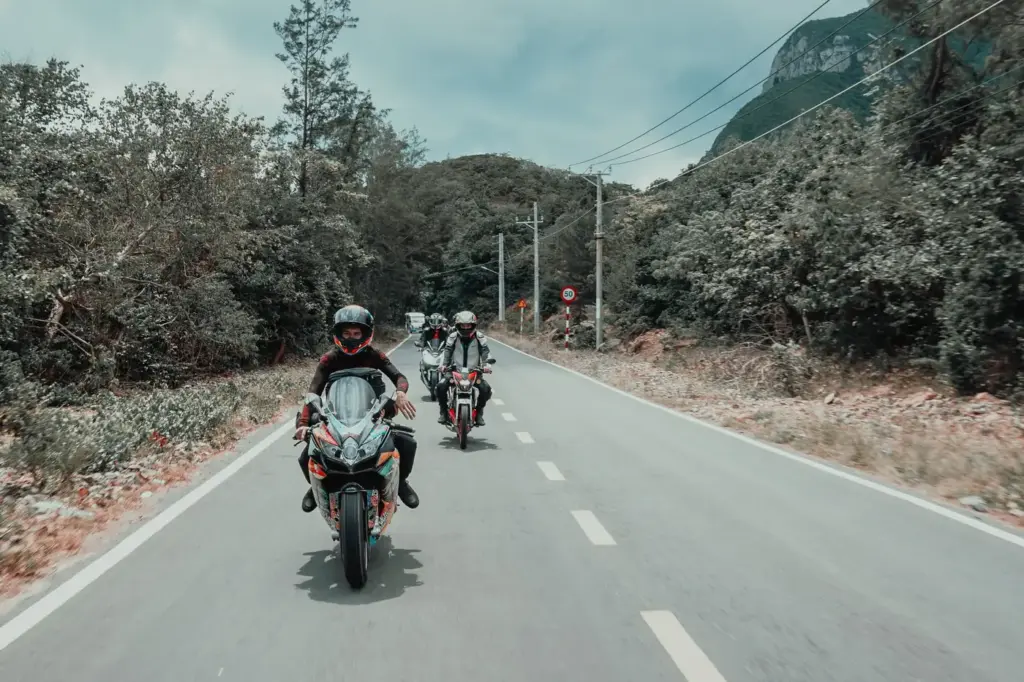
On the road: give each other room
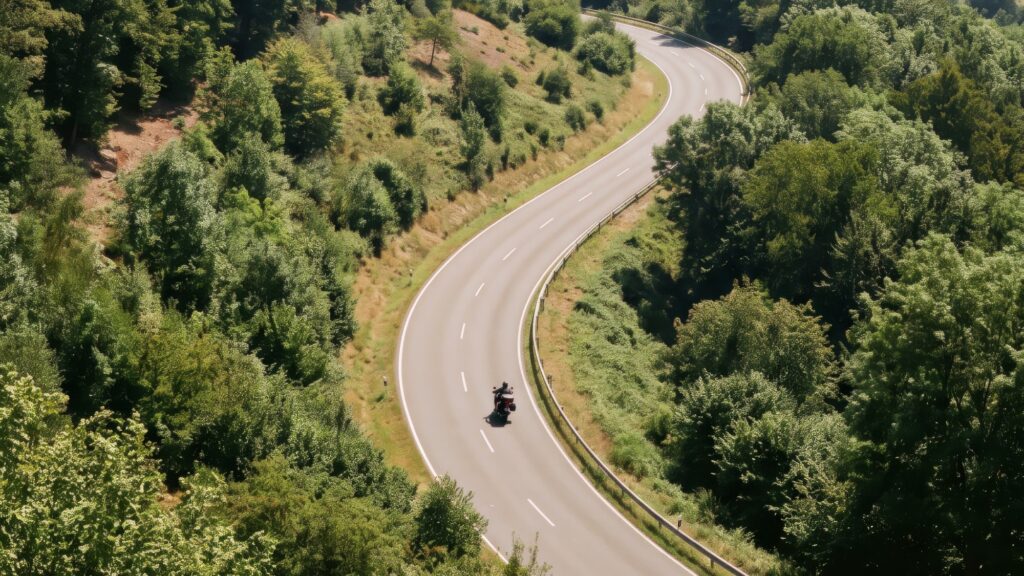
On straight roads many groups ride in a staggered formation: the leader on one side of the lane, the next rider on the other, and so on. Everyone keeps a view of the road ahead and more room to brake than when riding nose to tail. In bends and on narrow roads, ride single file and pick your own line.
Most important of all: ride your own ride. A group should never push anyone faster than they want to go. If the pace is too high, say so at the next stop, or put the most relaxed rider second, right behind the leader, who then sees straight away when the pace is too much.
Plan the breaks before you need them
A group is slower than a solo rider and stops more often. The ride time on a route page is an estimate of time on the bike. Coffee, fuel and waiting come on top of it.
- Fuel to the smallest tank. The bike with the shortest range decides where the group fills up. Ask before you leave who hits reserve first.
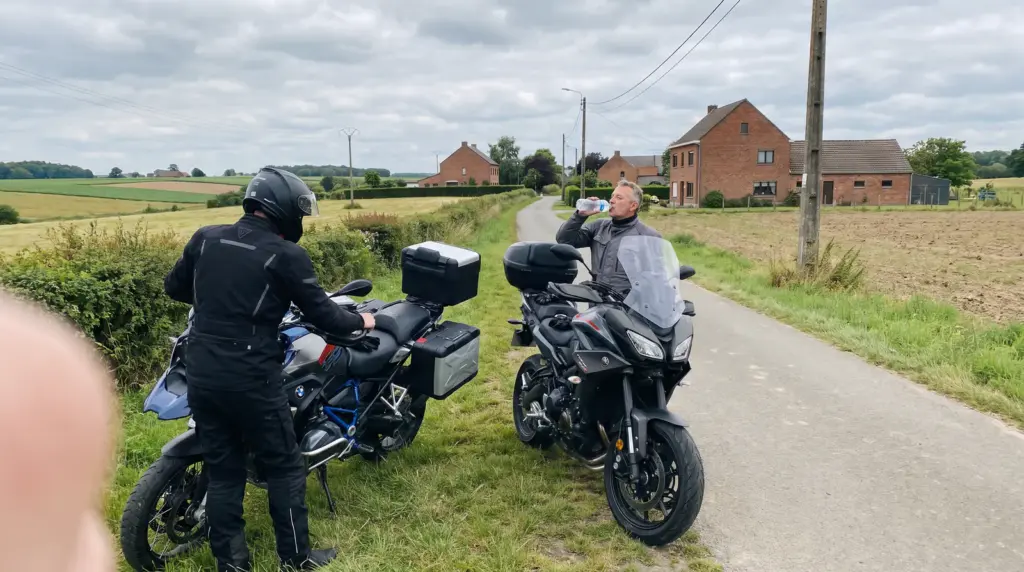
- Drink at every stop. Under a helmet you often notice thirst late, even on a cool day. A bottle of water in the top box is quick to grab.
- Choose a good place to stop. A car park, a village square, a wide verge or a quiet side road, where everyone can get fully off the carriageway and be seen from both directions. Not just after a bend, and not on the crest of a hill.
Riding as a pair
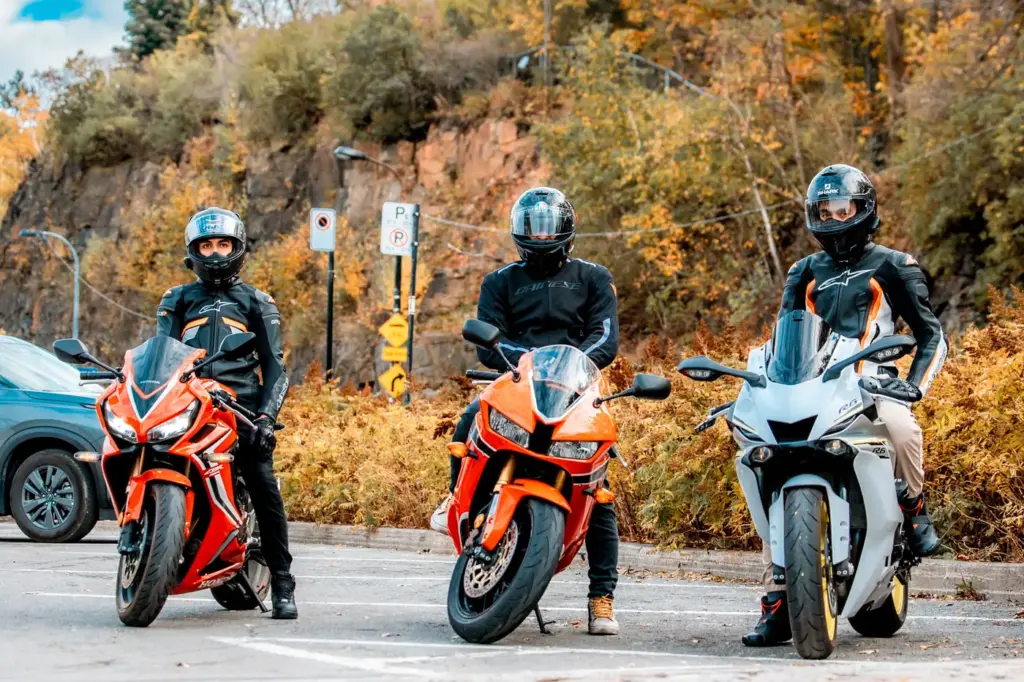
With two riders everything is simpler, but the same habits help. Take turns leading, so the same person isn’t navigating all day. Agree on a hand signal for fuel and one for a break, or use an intercom if you both have one. And if you ride very different bikes, say an adventure bike with panniers and a sport tourer, plan around the range of both and around roads where one of you is less comfortable.
Three loops to ride together
Three loops on Motarva, in Belgium and the Netherlands, that fit an easy day with breaks, each with a different character. The figures come from the route pages.
| Route | Distance | Ride time | Curviness | Start and finish |
|---|---|---|---|---|
| De Kust | 154 km | 2 h 25 min | Medium | Koksijde |
| Zuid-Limburg | 127 km | 2 h 40 min | High | Heerlen |
| Houffalize | 135 km | 2 h 55 min | High | Houffalize |
De Kust: the most relaxed of the three
A 154 km loop from Koksijde on the Belgian coast that, according to its description, also crosses into France, with 348 m of climbing and medium curviness. It is the longest of the three in kilometres and yet the shortest in ride time, which is exactly why a group should plan on ride time rather than distance.
Zuid-Limburg: short but twisty
127 km from Heerlen in the south of the Netherlands, crossing into Belgium according to its description, with 1,611 m of climbing and high curviness. Short enough to leave time for a long lunch, but it asks more of the group than the coast loop.
Houffalize: for a group at home in the bends
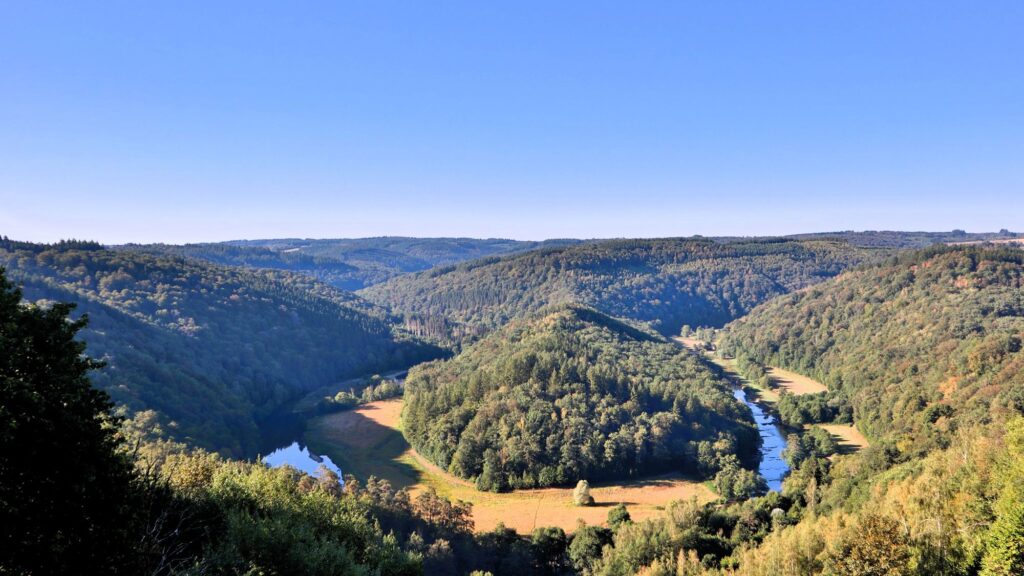
135 km through the Belgian Ardennes, with 2,306 m of climbing, high curviness and the longest ride time of the three at 2 h 55 min. Pick this one when everyone in the group is comfortable on twisty roads.
View the Houffalize route or see more motorcycle routes in the Ardennes.
Map data © OpenStreetMap contributors (ODbL).
Group rides in the Motarva app
Riding with the Motarva app on iPhone? Your group can send signals on the move: Fuel, Break, Slow down or I’ve stopped. One tap and the other riders’ phones say it out loud, so nobody has to look down. Group rides are part of Motarva Pro, the optional subscription in the app. More about the Motarva app.
Frequently asked questions
Does everyone in the group need an account?
Not to view the route. To download the GPX, each rider needs a free Motarva account.
What if someone loses the group?
If everyone has the route on their own device, that rider simply carries on to the next agreed stop. That is why sending the route round beforehand is the most important tip in this article.
Will a Motarva route work on my sat nav?
You download the route as a GPX file, the format most sat navs and navigation apps read. If your device expects a different format, read GPX, TCX, FIT and ITN explained.